The Blueprint to Senior-Level Code: Reverse engineering a Modular Full-Stack Architecture.
Most apps fail quietly not because of bad features, but because their architecture couldn’t handle growth. Architecture is what determines whether your app grows or collapses under its own weight. If your project becomes harder to change with every feature, you’re accumulating architectural debt.
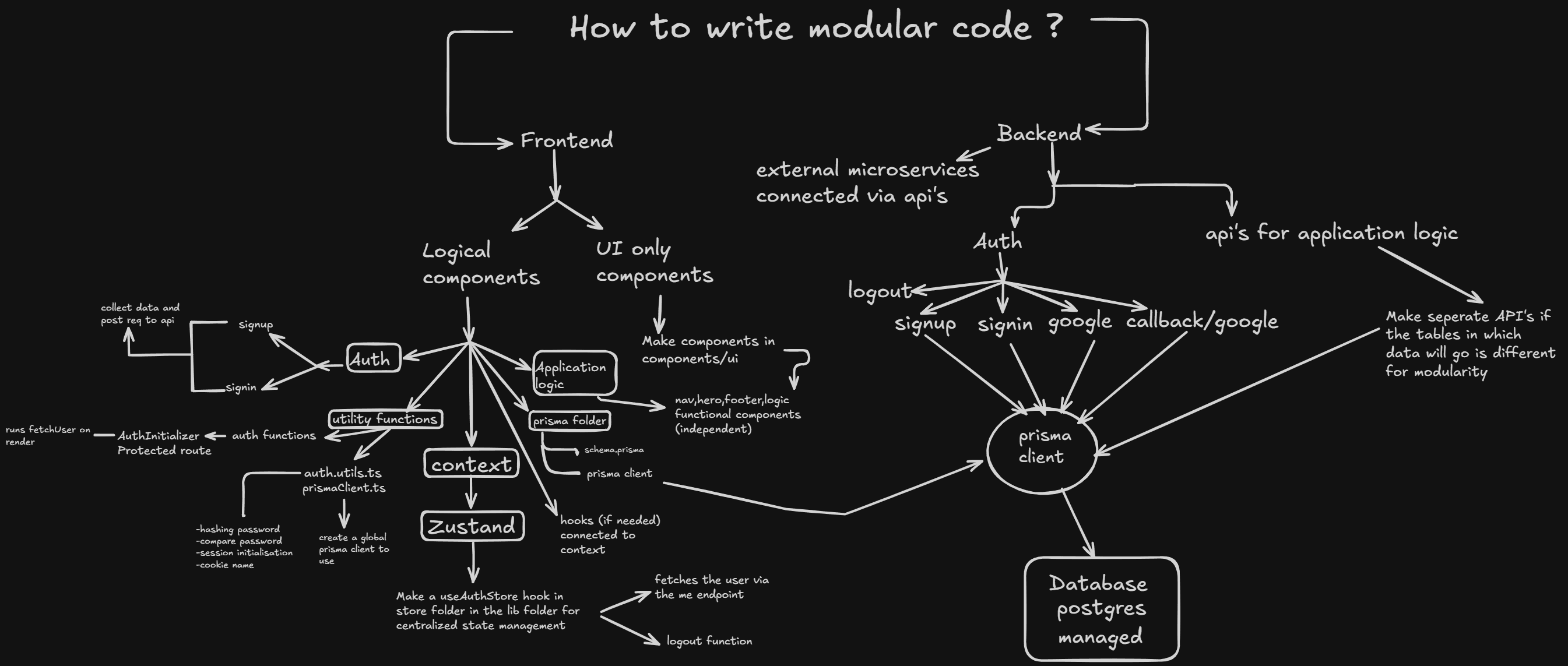
Architecture for writing Scalable full-stack applications without Monorepos
We are going to analyze this architectural diagram to understand how to build systems designed to grow.
1. Going 0–1
Let me set the context for this blog: The top two branches of the diagram, Separation of Concerns between the Client (Frontend) and the Server (Backend). Frameworks like Next.js blur the lines with server-side rendering, this diagram reminds us that logical separation is crucial.
2. Setting Up the Frontend the Right Way
2.1. UI Only Components
These components should be purely visual. They take data in via props and render it. Location - components/ui. Why do this? Reusability.
2.2. Logical Components
These components handle the heavy lifting. They make the API calls, they validate form inputs, and they decide what to show the user based on data. Location - Auth, Application logic. Often called the Container/Presentational pattern, this approach enforces a clear separation between side effects and rendering.
2.3. State Management
- The Zustand Store (useAuthStore): A single location in your
libfolder that holds global data (like the current user). - AuthInitializer: The diagram shows a crucial UX flow: running
fetchUseron initial render. This checks the session immediately to decide if the user sees the dashboard or gets booted back to the login screen. - logout function: Ensuring that when a user logs out, the entire app updates instantly.
2.4. Authentication Flow
- Sign-up/Sign-in: These components collect user credentials and post requests directly to the backend API.
- Protected Routes: Logic that wraps around pages to ensure only logged-in users can see specific content, otherwise redirecting them to the login page.
2.5. Utility Functions
Think of it like a toolbox for the application, containing logic that doesn’t belong in a component.
- auth.utils.ts: Contains logic for cookie naming, session initialization, and handling tokens. Examples: Token expiration, Password hashing & Comparison.
- prismaclient.ts: Responsible for creating a Global Prisma Client. This is a senior-level pattern used to prevent "exhausting database connections" during hot-reloads in development.
import { PrismaClient } from "./generated/prisma/client";

declare global {
  var prisma: PrismaClient | undefined;
}

const client = globalThis.prisma || new PrismaClient();

if (process.env.NODE_ENV !== 'production') {
  globalThis.prisma = client;
}

export { client as prisma };
2.6. Setting up database with an ORM (Prisma/Drizzle)
Interestingly, this architecture includes a prisma folder containing schema.prisma and the prisma client. In a full-stack framework like Next.js, this allows the frontend logic to have a direct, type-safe understanding of the database structure.
2.7. Hooks
We can imagine hooks as logic encapsulators. Instead of cluttering a component with useEffect and fetch calls, you move that logic into a custom hook like useApplicationData().
A hook like useAuth() internally subscribes to your Zustand store to get the user's status. This abstraction decouples UI components from the state management implementation. Swapping Zustand with Redux or TanStack Query requires changes only within the hook layer.
Checkpoint — What Have We Learnt Yet?
- A very scalable frontend design fully setup with authentication, application logic and database setup as well.
- Where and how to place components in a modular fashion.
- Hooks, utility functions & State management connections.
- Understanding how data flows between the above flows listed.
3. Setting Up the Backend the Right Way
3.1 API Design
Instead of one giant, messy file, advocate for Separation by Domain .
Using logical partitioning and connectivity.
3.2 The Authentication Branch
- Dedicated Endpoints: Specific routes for signup, signin, and logout.
- OAuth Integration: It manages the google callback, handling the handshake between your app and external providers.
- Utility Integration: This layer uses the
auth.utils.tsmentioned in the frontend section to perform critical tasks like Password Hashing and Session Initialization before saving data.
3.3 Microservices & Scalability
A key "Senior" detail in the diagram is the mention of External Microservices. Future Proofing: By separating your backend into clean API modules now, you can easily migrate a specific feature (like a payment engine or image processor) into its own independent microservice later without a total rewrite.
4: The Convergence: Prisma & Postgres
Everything in this architecture both the Frontend Logic and the Backend APIs eventually flows into the Prisma Client.
- The Prisma Client: It acts as the “Translator”. It takes your clean TypeScript code and converts it into optimized SQL that your database understands.
- Managed Postgres: The final destination is a PostgreSQL Database. By using Prisma, you ensure that every piece of data entering this database is type-safe and follows your defined schema.
5: The Conclusion
At its core, writing modular code isn’t about following a trend or adding complexity for the sake of it; it is about reducing the cost of change. Architecture is the “invisible floor” of your application if it’s weak, the app collapses as soon as you add a new feature. If it’s strong, like the blueprint we’ve deconstructed, the system remains predictable and manageable regardless of scale.
By adopting this structure, you shift your mindset:
- Isolate the UI: Keep your components "dumb" and beautiful so they remain reusable across any project.
- Encapsulate the Logic: Use custom hooks as the "glue" to ensure your UI never touches your data layer directly.
- Centralize the State: Use a global store like Zustand to maintain a single source of truth and kill prop-drilling forever.
- Secure the Backend: Treat every request as untrusted and organize your APIs by domain to ensure fault tolerance.
- Trust the Schema: Let an ORM like Prisma be your type-safe guardrail, connecting your database and logic with total consistency.